- #SugarFreeChallenge
- #KarenBentley
- #SugarFreeLiving
- #SugarFreeMiracle
- #ItsTheSugarStupid

- #SugarFreeChallenge
- #KarenBentley
- #SugarFreeMiracle
- #SugarFreeLiving
- #ItsTheSugarStupid
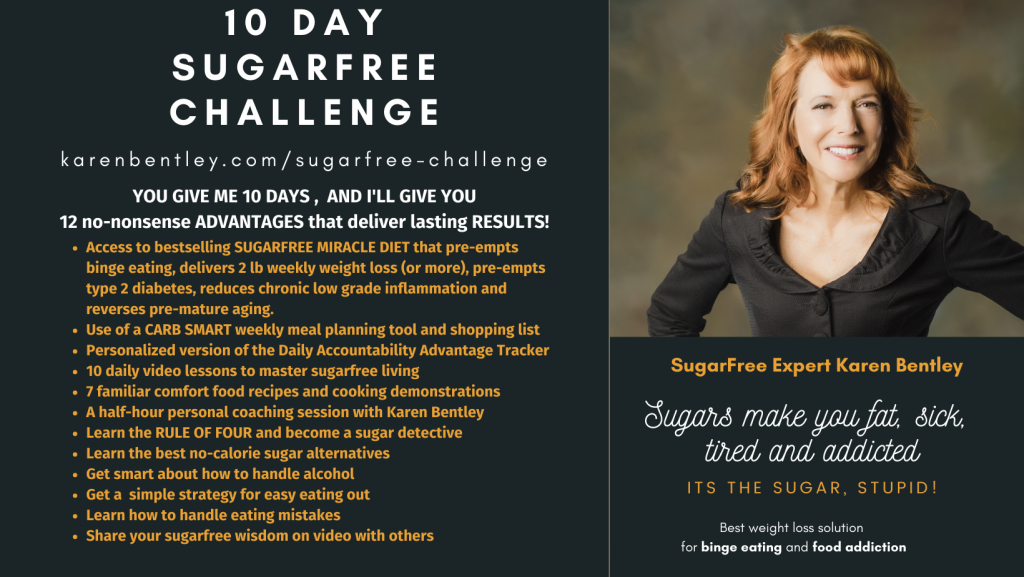
THE 10-DAY SUGARFREE CHALLENGE
A webinar that ENDS binge eating,
delivers 2 lb weight loss every week,
pre-empts type 2 diabetes,
reduces chronic low grade inflammation,
restores energy,
reverses premature aging
SIGN UP AT
www.karenbentley.com/sugarfree-challenge
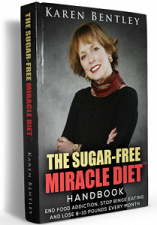
Based on
Karen Bentely’s bestselling
SugarFreeMiracle
Diet Handook,
rated 4.8 stars on Amazon.com
#karenbentley.com/sugarfree-challenge
#10daysugarfreechallenge #sugarfreemiraclediet
#karenbentley #sugarfreekaren
#itsthesugarstupid
***************
One smart, powerful eating program with SIX SOLUTIONS
SOLUTION #1: END food addiction and binge eating.
SOLUTION #2: END overweight or obesity
SOLUTION #3: REDUCE (or eliminate) predisposition to type 2 diabetes
SOLUTION #4: REDUCE (or eliminate) chronic low grade inflammation
SOLUTION #5: END fatigue and energy swings
SOLUTION #6: REVERSE pre-mature aging
SIX for ONE! How good is that. It’s time to get excited.
Testimonials from raving fans of Karen Bentley’s SugarFree Miracle Diet are peppered throughout. Here’s one.
Maureen D on October 30, 2015
Less hunger, less crankiness, less tiredness, less thinking about food. Wish I tried this sooner. Getting caloric sweeteners and flours out of my diet is a different way of eating that’s making a difference in the way I deal with food and in the way I feel.
GIVE ME 10 DAYS and I’ll GIVE YOU A NEW LIFE
🟥 Day 1
Lesson:
– Sugar 101: What are sugars; Glucose and Fructose
– Learn the rule of 4.
– Become a sugar detective and discover how to identify sugar and the big family of sugar relatives.
Cooking Demo: Sugar-Free Pancakes
Homework: Clean out your fridge and pantry
Homework: Take photo and baseline measurements
🟥 Day 2
Lesson:
– The SugarFree Miracle Diet Strategy
– How to develop an easy meal plan
– 4 Cookbooks worth getting
Cooking Demo: Chicken with salad
Homework: Modify the meal plan to your preferences
Homework: Shop for ingredients for the 7-day eating program
🟥 Day 3
Lesson:
– Addiction: A big reason to get sugar out of your food supply
Cooking Demo: Ziti with tomato meat sauce
Homework: Make the ziti meat sauce dinner
Homework: What do you want? What’s your goal?
Homework: Set your intention for the next 7 days
🟥 Day 4
Lesson:
– Weight Loss: Another big reason to get sugar out of your food supply
Cooking Demo: Chicken stir fry
Homework: Day 1 of the SugarFree Challenge
Homework: It’s a process – Track your first day of sugarfree living
🟥 Day 5
Lesson:
– Inflammation, Energy, Premature Aging: More reasons to get sugar our of your food supply
Cooking Demo: Cauliflower Pizza
Homework: Day 2 of the SugarFree Challenge
Homework: Make the chicken stir fry
Homework: It’s a process – Track your second day of sugarfree living
🟥 Day 6
Lesson: Alternative sweetening agents: What’s good, what’s not
Cooking Demo: Ham and cauliflower casserole
Homework: Day 3 of the SugarFree Challenge
Homework: It’s a process – Track your third day of sugarfree living
Homework: It’s a process – What’s going well, what needs refining
🟥 Day 7
Lesson: Eating out
Homework: Day 4 of the SugarFree Challenge
Homework: Review your intention and what you want
Homework: It’s a process – Track your fourth day of sugarfree living
Homework: Make the ham and cauliflower casserole
🟥 Day 8
Lesson: Alcohol and recreational drugs
Homework: Day 5 of the SugarFree Challenge
Homework: It’s a process – Track your fifth day of sugarfree living
🟥 Day 9
Lesson: Handling food mistakes
Homework: Day 6 of the SugarFree Challenge
Homework: It’s a process – Track your sixth day of sugarfree living
🟥 Day 10
Lesson: You’re the teacher – Share what you learned about sugarfree eating
Homework: Day 7 of the SugarFree Challenge
Homework: It’s a process – Track your seventh day of sugarfree living
and score your weekly performance
Homework: Take your photo and baseline measurements; compare to start
10 DAYS
to learn a carb-smart, strategic and simple eating program.
10 DAYS
to start losing weight: predictably, easily and naturally.
10 DAYS
to quickly begin losing inches and to feel physically good about self.
10 DAYS
to correct metabolism dysfunction and restore vitality.
10 DAYS
on your own schedule, in your own home, with your own foods, inspired by your own goals and dreams.
THE BEST PART: It’s safe. It’s easy. There’s no starvation. No hunger of any kind. No calorie counting. No carb counting. No fat gram counting. No pills. No special foods. No supplements. No torment. Easy peasy, baby!
Hi, I’m Karen Bentley, and my story is the same as yours. For most of my life I was a crazy food maniac. No matter what it was, I had to have the whole thing: a whole giant-sized bag of M&M’s, a big family-sized bag of chips, a whole pumpkin pie (or at least whatever was left in the pie dish)!
As you know, this is a seriously disruptive and unhappy way to live. But food is no longer an issue in my life, and it hasn’t been for many years. I don’t obsess about what I’m going to eat or when I’m going to eat. I don’t worry about how I’m going to deal with lunch or dinner in a restaurant. And I don’t stress out about holidays or parties. Bottom line: I’m free and sane, at least with food.
My sane eating began in 1998 and continues to the present day. The Sugar-Free Miracle™ Diet is a refined variation of the very same hunger-busting, satisfying, big food volume program that I used to get myself squared away. I made it easier, more powerful, and as lenient as it can possibly be to still deliver a result.
 Craig W. Markert, MD
Karen Bentley understands weight management. She knows that losing weight and gaining weight are predictable outcomes based on the way that you eat. Her book will help you to lose weight and to keep it off because it’s written by someone who passionately lives, teaches and writes about successful weight management.
Would You Give An Alcoholic A Drink?
Food addiction is, well, an addiction
This question is for real. Would you offer an alcoholic a drink? If your answer is no, then why would you give a binge eater or a food addict drinks or foods that are made with sugar? The situation is exactly the same, but there’s cultural resistance around awareness that sugar is an addictive substance. There’s intermittent messaging about “no bad foods,” which is a lie. There’s social acceptability around pigging out. And there’s ongoing encouragement to eat this, try that, time off won’t hurt you. All these complicating factors make it essential to recognize that food addiction is a tricky and especially difficult situation to manage. For one thing, we have to eat. It’s not possible to simply stop eating as can be done with drinking and drugging. It is, however, possible to stop eating sugars, the common, toxic addictive substance that triggers binge eating.
For the purpose of convenience and abbreviation, the term sugar is used here in a generic, collective way to mean every kind of sugar, including granulated sugar, confectioners sugar, brown sugar, turbinado sugar, sugar in the raw, crystalized sugar and all other variations on the sugar theme. Also included are other caloric sweeteners and sugar relatives such as molasses, maple syrup, corn syrup, agave syrup, glucose syrup or any product with the word syrup in it. And lastly, highly processed white and brown flours as well as white rice are included in the sugar group because these foods quickly digest to sugar in the blood. That’s it. These are the culprits in the diet. These are the bad foods to be avoided.
The Link Between Sugar in the Blood
and the PLEASURABLE Dopamine it Releases
The Sugar-Free Miracle™ Diet strategy is based on the fact that sugars, other caloric sweeteners and highly processed flours that quickly convert to sugar are highly addictive trigger substances that lead to cravings and binge eating. How does this happen? Because sugar consumption produces and releases a hormone-like neurotransmitter called dopamine that creates pleasurable, feel good sensations. Some people are more sensative and responsive to the presence of dopamine than others. These are the food addicts and binge eaters. It’s important to note the nerological dopamine pathway created by sugar consumption is similar to the neurological pathway created by consumption of cocaine. New research, in fact, shows that mice pick sugar over cocain to pleasure themselves. The research also demonstrates how sugar has the same brain pathways as alcohol and other recreational drugs.
For binge eaters, there’s yet another problem with the pleasurable sensations presented by dopamine, and this is because dopamine overrides feelings of fullness. Eat when hungry, stop when full sounds easy, logical, doable, but it doesn’t work. The presence of dopamine overrides and distorts feelings of fullness, which then makes it impossible to rely on them for eating decisions. Clear boundaries and simple rule-based eating gets dopamine production under control and restores reliable sensations of fullness.
“Binge eaters don’t need to take a test or get a diagnosis. They already know they binge eat. “
No Talk Therapy Needed!
The only way that change happens is when a different behavior is performed. The one requisite behavior for the 10 DAY SUGARFREE CHALLENGE is sugarfree eating. Going sugarfree gets it done. Talking about feelings, problems, obstacles, past history, ancestral genetic DNA curses, mommy or daddy issues, or anything else that invites procrastination doesn’t get it done. Bottom line: You can’t talk binge eating away. The solution requires a decision, a firm consistent decision to get sugars out of your food supply. It doesn’t have to be a lifetime decision, but it must be a full-bodied temporary decision, which means faithfully doing what it takes for a pre-determined amount of time. Take the 10 DAY SUGARFREE CHALLENGE and let the miracle work for you. Then you’ll have your own fact-based experience as a guideline for progressing.


At my heaviest I weighed 219. It was way too much for my frame. My body was very, very unhappy. I am just not built to carry that kind of weight. Weight’s been an issue since I had my son… marriage… divorce… it all kind of started then. Up and down. I tried many things, and they all worked. I’d get down to maybe 140 or 150 or something like that, and I’d be pretty satisfied with that for a while, and then I’d gradually inch back.This last time was the most I’ve ever weighed.
It was just horrifying.I was afraid because of my age now and because it had gotten really out of hand that my health was in danger. I couldn’t stand to look in the mirror… and on top of that I felt horrible. I had no energy. It hurt to get up off the couch to move. My joints hurt. I’d be out of breath very easily. I had no motivation. You know, it was hard to get up in the morning. It was really just not a good way to live.It all kind of started last year… I had weight and being unhappy heavy on my mind…I just wanted to make a change…
And that kind of started me on this path of change, taking control of my life and thinking differently and talking differently to myself and treating myself better and appreciating who I am and the things that I really have in my life. And then I started working on the Dr. Pat Show, and you were one of the first people that I connected with, and after talking with you and going to your website… this was like the last little segments that needed to click into place for me, and I just knew that this was what I was looking for and what I needed.
THE 10-DAY SUGARFREE CHALLENGE WORKS!
Keep in mind The Sugar-Free Miracle Diet system was specifically develop by and for out-of-control eaters. This makes it radically different from every other diet. Keep in mind that low-fat, low-calorie diets exacerbate out-of-control eating because the experience of hunger exacerbates craziness with food and eating low fat foods made with sugars and flours contributes to the confusing no bad foods messaging. Foods made with sugars and flours are not okay. Enough already. This is the program for you.
This programs works whether you’re a woman or a man. And yes, men are crazy with food, too. It works if you’re 20 or 50, 60, or even 70. And eating this way can easily add 5, 6, or 7 years to your lifespan. 10 years off your biological age.
Most importantly, the 10 DAY SUGARFREE CHALLENGE works for people who feel like they have fat genes and are “destined” to have an addictive personality or are “destined” to be fat. This is nonsense. you may have a genuine genetic predisposition, but you don’t have to give into it.
Charlotte B (from New Hampshire)The Sugar-Free Miracle™ Diet is a winner. It’s a simple premise with a simple solution and path to losing weight… You have convinced me that sugar and processed foods are bad! The diet is reasonable, doable, and not overwhelming.
Have you ever considered doing nothing?
Choices, choices, choices. Here’s the one for doing nothing.
Accept your out-of-control eating behavior.
Accept your excess body weight.
Accept your body fat.
It’s tempting, isn’t it. Doing nothing is the easiest solution, but it’s the least satisfying solution, and it’s hard to feel good about yourself when you continually eat in a harmful way. Unfortunately, out-of-control eating does not run out of steam or stop on its own. It stays with you unless you take some kind of action to stop it. Doing nothing is the attempt to make do with it. Keep in mind the energy you expend making do is ultimately greater than the energy required to go sugarfree. Never, ever give up on yourself.

Judy F (from Massachusetts) Lost 40 Pounds on The Sugar-Free Miracle™ Diet
Weight has been an issue in my life since I was 13 and up. I’ve been on more programs than you can imagine. I was on Diet Workshop. I did Weight Watchers. I did the Zone. Everything worked, but it didn’t work. A couple of them you have to go to classes, and I don’t have time for that. The Zone was fine, but you’re always concentrating on combinations. I was looking and looking and looking for something.
I saw your ad and read it and I couldn’t wait to call. I needed something. I was dragging, and I was putting on the weight. And more than putting on the weight was the compulsion with food. And I knew in my head if I hooked into something good, it was going to turn around for me.It took 24 hours to start feeling good. I just noticed that within 24 to 36 hours the cravings disappear.
My eating is so different now. I’m not compulsive. I’m not all the time eating whatever. I don’t have any cravings. I don’t crave any potatoes, rice or any of that stuff. The only craving that I have is for nuts, and I look forward to my daily nuts. I have a snack with nuts. I make different mixtures. And that’s it. I’m full. It’s amazing. But the best thing, the best is the energy. The energy is amazing. I have more energy than my 15-year old daughter. I’ve gone through a lot of things right now with losing my mother, and my dad’s been in the hospital for a month. And the energy I have is wonderful. I just have this energy 24 hours a day.I can manage this program anywhere. So, like in the hospital, I go down to the cafeteria, and they put a salad bar out every day. I always carry around a piece of fruit with me. And I’m a water freak. On the road I have my fruit or my nuts. When my husband I go out, I know where to go and what to order. I eat three meals, and when I’m cooking I really make everything flavorful. I always have a snack or two. I love it.
This is the way I’m going to be. There’s no maintaining. It just is. I’m not thinking about what I’m going to be eating. It’s automatic. I don’t need time off. You know what I mean? I’m off. I’m contented.
Regarding success tips for others, the first thing is you’ve got to read this book. That’s huge. They’ve got to do the workbook, too, which I did every day, and it was wonderful, too. The writing in the workbook is very important. It helps you to focus on what you’re doing. I also think that people shouldn’t get on the scale. But I finally got on the scale the other day, and I took off maybe 40 pounds.
There’s all kinds of programs out there. This works. I feel good. And I don’t feel like I’m doing anything unusual. If more people did it, it would be wonderful, because they would feel good, too. My ideal weight is about 125 to 130. I never got on the scale, so I don’t exactly know how much I weighed. At my worst I was into size 16 and getting sick about it. Now I’m a 10. I love it. It’s wonderful. Thank you, Karen. I’m so glad I saw you in the newspaper.
It’s The Sugar, Stupid!
Caloric sweeteners (including sugar and all the sugar relatives) are the most toxic, addictive substances that make you fat, sick, tired and crazy with food. THE DILEMMA
In the 1970’s our national daily consumption of fat was about 40% and our national obesity rate was stable at 13%. Today our national daily fat consumption is down to 34%, a statistically significant change that didn’t happen by chance, yet the national obesity rate has dramatically tripled to 90 million adults, and is still going up.
- 172 million adult Americans are either overweight or obese.
- 29 million adult Americans have type 2 diabetes and another 86 million have pre-diabetes.
- 118 million adult Americans have at least one risk factor for heart disease.
- 73 million adult Americans have high LDL (the lousy) cholesterol.
- Up to 40% of dieters suffer from binge-eating, out-of-control eating or food addiction.
Here’s a hint. Sugar and other harmful caloric sweeteners went under the national and world radar and stayed there for 60 years. At long last, it’s time to consider that the much-maligned Robert Atkins might have been right when he said “sugar is metabolic poison.” The smartest way to progress out of this health pickle is to recognize the sweetening agents in our food supply and learn how to more carefully manage them.
The Sugar-Free Miracle™ Diet Handbook breaks this unhealthy pattern, resolves the problem of out-of-control eating, and teaches you how to consistently and easily lose 8-10 pounds every month.
Learn these life-changing skills
- How to identify sugar and the big family of sugar relatives. All caloric sweeteners are equally addictive and troublesome.
- How to tell the difference between glucose and fructose and why they’re both problematic.
- Why the glycemic index is an incomplete, imperfect tool
- The three types of foods that are most likely to cause obesity
- The relationship between obesity and type 2 diabetes
- How caloric sweeteners cause inflammation, the underlying cause of every chronic major disease you don’t want.
- A new understanding of LDL cholesterol and why it might be protective rather than harmful
- How sugar impacts the spread of cancer
- How glucose and fructose contribute to food cravings, hunger and out-of-control eating
- Which no-calorie and low-calorie alternatives to sugar are safest
- How to read food labels and make smarter decisions about foods and drinks that come in a container.
About Karen Bentley
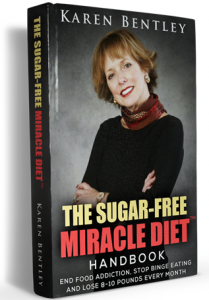 Karen Bentley is a bestselling author, health educator, speaker, blogger, the former founder of the Sugar-Free Institute and the former radio show host of the weekly MyThinLifestyle program.
Since 1998 she’s been a passionate leader in the sugar-free movement. Bentley is the creator of The Sugar-Free Miracle Diet system, a key contributor in The Sugar-Free Miracle Cookbook Collection, and the inventor of her one-of-a-kind, transformational End Food Addiction Bootcamp.
Bentley has a B.S. degree in education from Northeastern University where she graduated summa cum laude, class valedictorian and winner of the Boston Bouve’ Award for academic achievement.
Raving fans love The Sugar-Free Miracle Diet.
Check out what they’re saying…
Marea Kerrigan
Donna Edgars
Linda McDonald
John Keator
Laurie Friedman
 Samantha B (from the UK) lost 30 Pounds on The Sugar-Free Miracle™ Diet
I have been battling with my weight for more than five years. Aged eighteen, I went to university and suddenly had the freedom to food shop on my own. The pressure of studying was immense and my refuge was the biscuit and chocolate aisle of the supermarket.
I would fill my basket to the top – sugar and chocolate galore – and head back two days later, having already polished off the remains. The weight rose until I was 168 lbs, a 56 lb and 50% body increase on my tiny, teenage body.
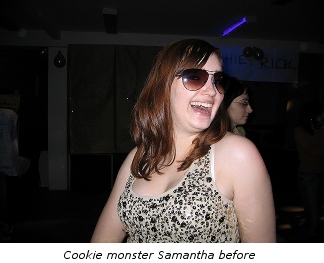 My weight has risen and fallen every year for many years: a battle of conflict, in every way. I recall what should have been evenings of great fun and chit-chat with friends, but needing to ask them to please leave, feeling so full and so sick from having over eaten.
I can also recall the countless diets I have begun, even giving hypnosis a go. They would work until I began to crave the foods I loved, and the diet and my life as a slim person would be over.
Travel is my passion and since graduating, I have worked my way around the world. I was most fortunate to personally meet Karen, in a chance of extraordinary coincidence, while aboard my cruise ship the M/S Nautica. Karen taught me a lot about self-love, self-respect and the limiting of sugar without sacrificing great taste.
I disembarked and passed through a four month journey of personal growth and acceptance. The need to over-eat quietly slipped away. I have my sugar fix now only on weekends, a system that works like clockwork for me. I snack on baked chips and low sugar cakes in the week, and then indulge in some extra calories and chocolate at the weekend. By Monday, I am controlling the sugar and hitting the gym, and Tuesday always shows a healthy figure on the scale. I stopped bingeing. Just like that.It felt easy.It has been more than four months now and I have not wavered from this. Never before have I “stuck” with a “diet” for this amount of time.What I am doing RIGHT NOW is actually pretty damn fine.I have lost almost 30 lbs, and I rest easily at 140 lbs. The blurry edges of life are now clearing into a future full of sunshine: thank you Karen!
Be A Sugar Detective
Are you finally ready to stop being crazy with food?
The size of the adult population addicted to food is not known, and it’s not well studied. Estimates range anywhere from 20% to 30% of all dieters, but of course, this number could be much higher. Why? Because people usually keep out-of-control eating a secret and they don’t report it. Women are more likely to binge than men, but men are not exempt.
If you’re an out-of-control eater, you already know it. You don’t need to take a test or have an evaluation.
Yes! I want to stop binge eating and being out-of-control with food.
Yes! I want an easy weight loss program that doesn’t feel like a diet.
Yes! I want to conquer my cravings.
Yes! I want to shrink at least one body size per month.
Yes! I want to lose my belly fat and my thunder thighs.
Yes! I want to enjoy food by putting fat back into my diet.
Yes! I never want to be hungry with miniscule portions.
Yes! I want to be happy with the way I feel about myself and the way I treat my body.
Yes! I want to eat “normal” food that I can buy in a grocery store or find in a restaurant.
Yes! I want to learn how to eat in a practical way that I can sustain for a long time.
Yes! I want an affordable solution.
Yes! I want to start right away.
 Kevin C. (from Montana) reversed allergies and lost weight on The Sugar-Free Miracle™ Diet
Hi Karen, I wanted to thank you for writing your book, Sugar-Free Miracle [Diet Handbook]! I have been on this new way of eating since December, and I feel great!
What motivated me to try it was the part where you were saying too much insulin in your system can cause all sorts of symptoms which included asthma and allergies. (Also, the part that says sugar makes you sick, tired, hungry and fat.) My breathing has improved, my allergies went away, and I have lost weight.I have tons of energy, and when I eat I feel satisfied.When my family and I went to a buffet for Easter this month, I found that I ate a fraction of what I used to, and I felt full.
I am amazed. I tell all my clients (I’m a massage therapist) about your eating system, so I hope more people are downloading your book. I know it has changed my quality of life for the better! Thanks again.Kevin C, LMT, NCTMB
The Three Eating Commandments
for Out-of-Control Eaters
These are the three super simple eating strategies that enable you to finally make peace with food and to get skinny. I’m giving you these three powerful, life-changing strategies completely for FREE. More than anything, I want to empower you to help yourself and I want you to be successful.
Commandment #1: Get the sugar and other caloric sweeteners out of your food supply. Foods made with caloric sweeteners are problematic because they lead to food cravings and they trigger binge eating. Caloric sweeteners are a universal problem for all out-of-control eaters. Your new mission is to learn how to identify all caloric sweeteners and either eliminate or manage them.
Commandment #2: Put fat back into your diet. Fat is essential for flavor. Fat is essential for fullness. Fat is essential for your satisfaction. In short, fat is your friend. Want even more good news? Here it is: fat doesn’t make you fat
Commandment #3: Eat yourself thin with big food volume. Out of control eaters must never, ever deprive themselves with bird-like portions of food. Ever. This is a key success strategy. It’s very important to not experience hunger and to not have the sensation of an empty belly. Commit right now to making yourself healthy and skinny with the joy of big food volume.
My First Customer Was Me!
 Altogether I lost 130 pounds on The Sugar-Free Miracle™ Diet. Well, more accurately I lost 70 pounds once; then regained most of it, and I had to take off 60 pounds all over again – which comes to a total of 130 pounds.
Obviously, I preferred to learn the hard way that I can’t handle caloric sweeteners without triggering binge eating and pigging out. I offer you tangible, living proof that someone who is completely ordinary in every way can solve a lifetime weight problem and a never-ending battle with food.
Sugar-free Expert
My own life-long issues with body weight inspired me to learn as much as I could about out-of-control eating and what it takes to have a healthy lifestyle and healthy body. My background continues to inspire me to be of service to you.
As a young adult I earned a degree in exercise physiology from Northeastern University where I graduated as Class Valedictorian. I’ve also been formally and informally studying nutrition and weight loss practices for more than 20 years. During this period I wrote four diet books. The best content from all of them was updated, refined and incorporated into The Sugar-Free Miracle™ Diet Handbook.
By the way, if you happen to be cruising around on amazon.com for food addiction and out-of-control eating solutions, you may notice that previous diet books by me are still available from re-sellers, but they’re out of print and out-of-date.
 Stacey M (from New Hampshire)
 Just finished your book, and I LOVED IT!!!! I am feeling highly motivated now and I think I will be fine, organizing, purging and buying the right foods the next couple of weeks. Your advice and book were really wonderful and comprehensive! As I said I am highly motivated now and ready to proceed.
The Truth About High Fructose Corn Syrup
High Fructose Corn Syrup (HFCS) was introduced into the U.S. food supply in 1978. It was designed to taste just like sugar, and it does. Most people can’t tell the difference. HFCS is cheaper to make, easier to store, and easier for food manufacturers to incorporate into their recipes. Consequently, it quickly became the dominant sweetening agent in the world.
 Experts used to think that HFCS was a healthier choice than sugar because it has a lower glycemic index. This is because fructose and glucose metabolize differently.
Glucose, for example, is metabolized and then shows up in the blood stream as blood sugar, which is measured on the glycemic index. Fructose, however, goes directly to the liver where it’s converted to triglycerides. Triglycerides are not measured on the glycemic index. Consequently, foods and drinks with a higher proportion of fructose than glucose have a lower glycemic index measurement. And this is why agave syrup, for example, has the false reputation as a health food.
We now know that fructose is largely implicated in the obesity epidemic, and the consumption of fructose leads to a dramatic increase in girth (a bigger horizontal size) even when there’s no increase in body weight. Consequently, people no longer want HFCS in their drinks and food products. It’s no accident that food manufacturers are advertising products made with “real sugar,” but there’s really no health or weight advantage to having “real sugar”. Both HFCS and sugar are equally problematic.
Like sugar, HFCS is an addictive, toxic substance that needs to be carefully managed or eliminated.
Angela S 5 Stars! The Sugar-Free Miracle Diet Handbook is amazing. I feel so happy and relieved about coming in contact with this book. Here is my own feel about it. Firstly, this provides a direct approach to solving the problem of overeating.
I am happy because not only has it enlightened me, but also it goes a long way to validate any statement scientifically. Another interesting feature about the book is that it still encourages the intake of food but advice against intake of caloric sweeteners that increases the release of insulin.
Its recommendations are constructive, logical and feasible. I also understood how important it is to maintain a carbohydrate-excess diet as carbohydrate excess is linked directly to increased fat storage, secondary to excessive insulin secretion.
The seven practical sugar-free miracle diet rules are so practical and easy to follow and am so happy it worked for me just after 3 weeks of consistent adherence. Thanks so much for this master piece and I think this book is a must read for our generation.
It doesn’t get any easier!
The Sugar-Free Miracle™ Diet is really an EASY eating program.
It’s EASY to understand.
It’s EASY to implement.
It’s EASY to sustain.
It’s EASY to lose weight.
Average-sized people typically lose about 8-10 pounds a month until a weight that’s proportional to height is reached.
And best of all… It’s EASYto feel good about yourself.
 Alexa N
This book really helped me in my struggle to not only lose weight but to become more healthy as well! After ordering the book, I rigorously followed the 3 steps that are outlined throughout the book and within the first week I had lost about 9 pounds.
Not only do I contribute my quick weight loss to following this book, it was also very well written and a great read to gain information from to share with people you love. I had a problem with stress eating and binge eating and I feel like the author outlined not only the cause of my problems but gave me easy solutions and guidelines on how to fix them. I would absolutely recommend this book to anyone who has a week to dedicate to really working on their food problems or addictions.
The Sugar-Free Miracle™ Diet Advantages…
- An easy-to-remember eating strategy that can be implemented at home, at work, in a restaurant, at a friend’s house, at a wedding, on a cruise, or anywhere else you happen to be.
- Just seven simple Sugar-Free Miracle™ Diet rules that anyone can follow.
- How to eat up to 4 pounds of food every day so you’ll always feel full and satisfied.
- Which artificial sweeteners are okay and how much of them to use.
- Why high fat foods are desirable and why they should be eaten every day.
- How veggie overdosing works and when you should do it.
- How to accelerate progress, once in a while, with the PUSH WEEK to breeze past plateaus or to force weight loss.
- Whether or not to drink any alcohol.
- How to select foods based on the Red-Yellow-Green classification system.
- How to prepare 15 easy-peasy snacks.
- What to do when mistakes happen.
- How to become a sugar detective.
- How to build a meal plan with familiar comfort foods.

Tony L (from Massachusetts)
I’ve lost 24 pounds on the Sugar-Free Miracle™ Diet System.
Get A Proven Solution
It works. This is the most important thing you need to know. The Sugar-Free Miracle™ Diet delivers a long-term, permanent result. It’s also practical, fast and affordable. Don’t forget. There’s been 18 years of testing, refining and updating put into this program. Success rate is 75%, which is as good as it gets.
Berry Ice Cream
Even More Raving Fans
Being in the corporate arena means sitting at your desk 9 to 5; going home tired and binging on a couch in front of the TV. That’s the routine that I’ve adopted for a few years now. This has also been the reason as to why I have gained an extra 40 pounds in the past couple of years. Lack-luster, bland and colorless are the perfect adjectives to describe my life until I found Karen’s Sugar-free Miracle™ Diet.
Who would have thought that the secret to losing weight is eating more?? Yes eating more! The secret is not starving rather eating healthy. As I turned the pages of the book I realized how dieticians have misguided me in the past. Karen’s book is so organized; starts off with the hidden truth, followed by the golden steps to adopt and then as a bonus, it incorporates the perfect recipes.I have lost almost 12 pounds in the last month thanks to the genius literature.
Everything it says makes sense, once you notice the change in your body. It’s not only that I’m losing weight but I’m also feeling more fresh in my daily routine which has helped me stay motivated at work. When my colleagues asked me which gym am I going to; I shared with them the wisdom and knowledge acquired from Karen’s book. Guess who was named employee of the month?
I highly recommend this book if you want to change your life for the good.
I didn’t realize how much impact the type of foods that I eat have on my food addiction. Before reading The Sugar-Free Miracle Diet Handbook, I was limiting consumption of fats. Now I’ve started to eat fats again, but I’m limiting consumption of caloric sweeteners and flours. This one change is really making a big difference for me. For once, I’m not constantly hungry or obsessed with food. Also, the advice to just concentrate on solving my issue with food is a big relief.
This is a guide to once and for all, getting this thing called eating and nutrition, right. From a focal point, two major camps of “baddies” are focused on: sugars and flours. I have read the revised version of Sugar Busters; which is a rundown of sugar’s harmful effects and the importance of understanding the GI (or glucose index) of varying foods.
The Sugar Free Miracle™ Diet was made for those suffering from certain food addictions, especially those that pack on the pounds. It’s no surprise that what’s in the typical processed American diet is worse than you thought.I got some good takeaways:
• Veggies are better by the pound. (I like to steam mine; keeps the vitamins in.)
• The GI thing can be a tad misleading.
• It is NOT my imagination that I always feel unsatisfied an hour later after filling up at the local Chinese buffet (I feel that I will have to rethink my initial fondness for these places)
• An easier way to interpret ingredients labels without going crazy (as so many listed things are hard to pronounce-and those things are the “baddies”.)Diabetes runs in my family and I know that I have to be mindful of my own diet, even more so. I’m glad to have this arsenal of better eating tips; I’ve gotten a chance to rethink what I’ve been eating, cooking, and shopping for.
You have to eat a lot of food on this diet, and I mean a lot. The guideline for veggies is 1.5 to 2.0 pounds per day, which is way more than I’ve ever eaten before. You also eat a filling amount of protein, a small amount of dairy, and one piece of fruit. I’ve been following The Sugar-Free Miracle Diet for about a week now, and there’s so much food, it’s easier than I thought it would be. So far, I lost 3 pounds.
If, like me, you have to eat a whole bag of chips or a whole box of cookies before you’re satisfied, then this is the book for you.Until I read The Sugar-Free Miracle Diet Handbook, I resisted doing without sugars and flours and instead relied on counseling and just eating healthy. It’s really very nice to have someone to talk to, but it didn’t do all that much for my eating problem or for my weight.I’ve also tried giving myself “a little” sugary treats because I really believed a little of anything couldn’t possibly be bad, but that hasn’t worked out either. For the past week, I’ve been living without caloric sweeteners or flours, and it’s going pretty well for me. I’m full. I’m not crazy with food. I’m feeling good about myself.
I found everything and made the cookies exactly according to your directions. Flavor was incredibly good. Loved them! A total thumbs up.
Out-of-control eating is a special problem
that requires a special solution
- Low-fat and low-calorie diets make out-of-control eating worse, not better. If you want to continue being an out-of-control eater, go on a low-fat, low-calorie diet. It’s a sure thing.
- Tiny, tasteless portions make out-of-control eating worse, not better. Any sense of deprivation works against the out-of-control eater.
- Even small amounts of caloric sweeteners can trigger a binge or lead to out-of-control eating. Why fight your own physiology? It’s faster and easier to get caloric sweeteners out of your system than forcing yourself to override the cravings and impulse to eat.
The Sugar-Free Miracle™ Diet is the specific solution you’ve been looking for to short-cut your struggle, stop out-of-control eating and lose weight!
 Hildegard E. Peplau, RN, EdD, Past President of American Nurses Association (deceased)
Karen Bentley is a splendid guide for taking personal responsibility for weight loss and health.
Brand New Edition
The Sugar-Free Miracle Diet™ Handbook is now available in a brand new edition that’s been completely revised and updated with 25% never-before published material. It has all the latest and greatest information and the most simplified eating program that’s possible that delivers a result.
Take the 7-Day SUGAR-FREE Challenge!
You can do this. You don’t need a special diet to go sugar-free. Just follow these 3 simple guidelines and then decide for yourself how to proceed.
- Make a decision to live without any caloric sweeteners for one full week. A caloric sweetener is sugar, HFCS, maple syrup, honey, agave syrup, and anything else that’s a sweetening agent with calories. Just try it and see for yourself the difference it makes in terms of energy, moods, feelings of well-being, and less cravings for food when you’re not hungry.
- Become a sugar detective and learn the “Rule of Three Ingredients.” Always check the ingredients list of any food or drink that comes in a container. Pass on any product where a caloric sweetener is one of the first three foods. Remember that water, spices, herbs, and chemicals are NOT foods.
- Go through your pantry and refrigerator and toss any tempting foods and drinks. If worse comes to worst and you hate being sugar free, you can always buy them again. In the meantime, you’re giving yourself an advantage of not having any handy trigger foods.
IT’S OKAY TO
– Eat foods with naturally-occurring sugar like fruit. What you’re concerned about are the sugars and other caloric sweeteners that have been added to foods.
– Eat artificial sweeteners and sugar alcohols, but no more than two tablespoons a day. Max.
– Drink one serving of alcohol or wine a day. Just make sure the drink isn’t made with a sugar mix. The big danger of alcohol is that it makes you more likely to forget your intention to go sugar-free. It also stimulates hunger. If you eat like a pig after you drink, consider passing on alcohol for a while.
 Bill B (from New Hampshire)
I lost 16 pounds on The Sugar-Free Miracle™ Diet. I’m a type 2 diabetic, and it really helped me to lower my blood sugar, too.
What Are You Waiting For?
Get Sane!
Get Skinny!
Get Healthy!
N O W
The Sugar-Free Miracle™ Diet Handbook is the bible of sugar-free eating. It’s just $7.49 and is available at Amazon.com.
Click here to buy a Kindle version of The Sugar-Free Miracle™ Diet Handbook
* * * * * * * * *
Pumpkin Bran Muffins
The Do-It-Yourself Diet Cookie
 Why spend $40 to $60 a week plus shipping and handling on the diet cookies that you buy online when you can get my Do-It-Yourself Diet Cookie recipe free when you subscribe to my newsletter! A $120 to $240 a month cookie budget is outrageous, and you’re not getting anything special you can’t quickly and easily provide for yourself.
Making your own cookies is a much cheaper, healthier, fresher and tastier option than anything that comes in a package. This delicious cookie recipe has big flavor, big fiber, big hunger prevention and big reliance on naturally-occurring, unprocessed healthy ingredients. There are no preservatives, no unpronounceable chemicals, no sugar and no wheat products in the recipe. It does, however, include some sucralose as the non-caloric sweetener, but if you prefer, any of the new stevia blends can be substituted.
More good news is that the Do-It-Yourself Diet Cookie delivers taste and fullness satisfaction, but without provoking binge eating or food cravings. Hallelujah! You can eat just one of these cookies without worrying about pigging out, and you will enjoy the eating experience very much.
The Do-It-Yourself Diet Cookie can be eaten either as a snack or as a convenient meal replacement. The one and only rule to remember is that you must drink a glass of water or non-caloric beverage with your cookie to enhance the filling effects.
I found everything and made the cookies exactly according to your directions. Flavor was incredibly good. Loved them! A total thumbs up.
You can even use the Do-It-Yourself Diet Cookie as a quick weight loss program, which is provided below, to kick your weight loss into high gear, to undo a weekend of indulging, or to break through a plateau. The quick weight program loss combines low-calorie, sugar-free eating strategies into an easy, practical, doable diet. A lot of experts think slow weight loss is better, but it isn’t. In fact, the people who see quick results are the ones who are the most inspired to keep going, whereas people who take off pounds slowly start thinking “why bother” and quit.
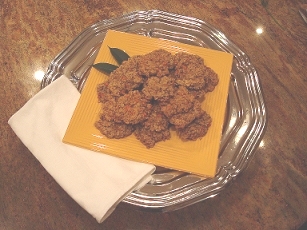
The Do-It-Yourself Diet Cookie quick weight loss program:
Eat one cookie as meal replacement for breakfast and another cookie as a meal replacement for lunch.
Eat one cookie as a snack in the afternoon and another cookie as a snack in the evening.
Eat a “real meal” of lean protein and greens for dinner. Protein should be 4-6 ounces of fish, poultry or lean meat. Greens should include 8 ounces of cooked veggies (anything except potatoes, beets or corn is okay) and 8 ounces of salad with calorie-free dressing.
That’s it. It couldn’t be simpler or more convenient. No meal planning burden. No big shopping list. No time-consuming meal prep. No wondering what you’re going to eat. Easy-peasy.
This isn’t the program you want to follow every day for the rest of your life, but it will help you to get jump-started and to see a quick result.
Subscribe to my newsletter and you can download the Diet Cookie recipe immediately!